
The Law of Conservation of Matter
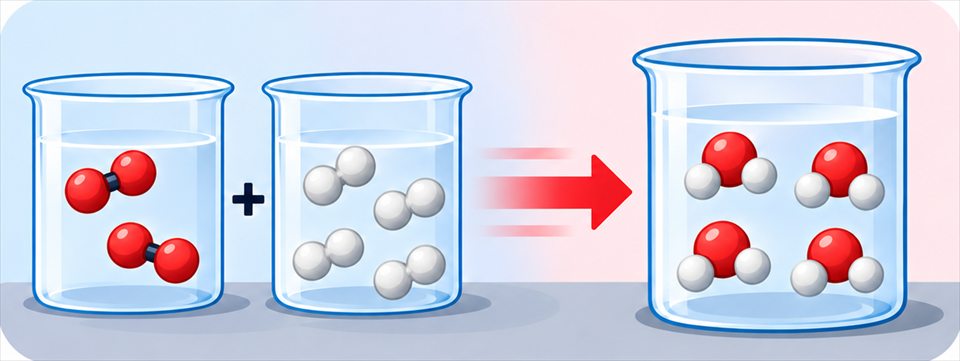
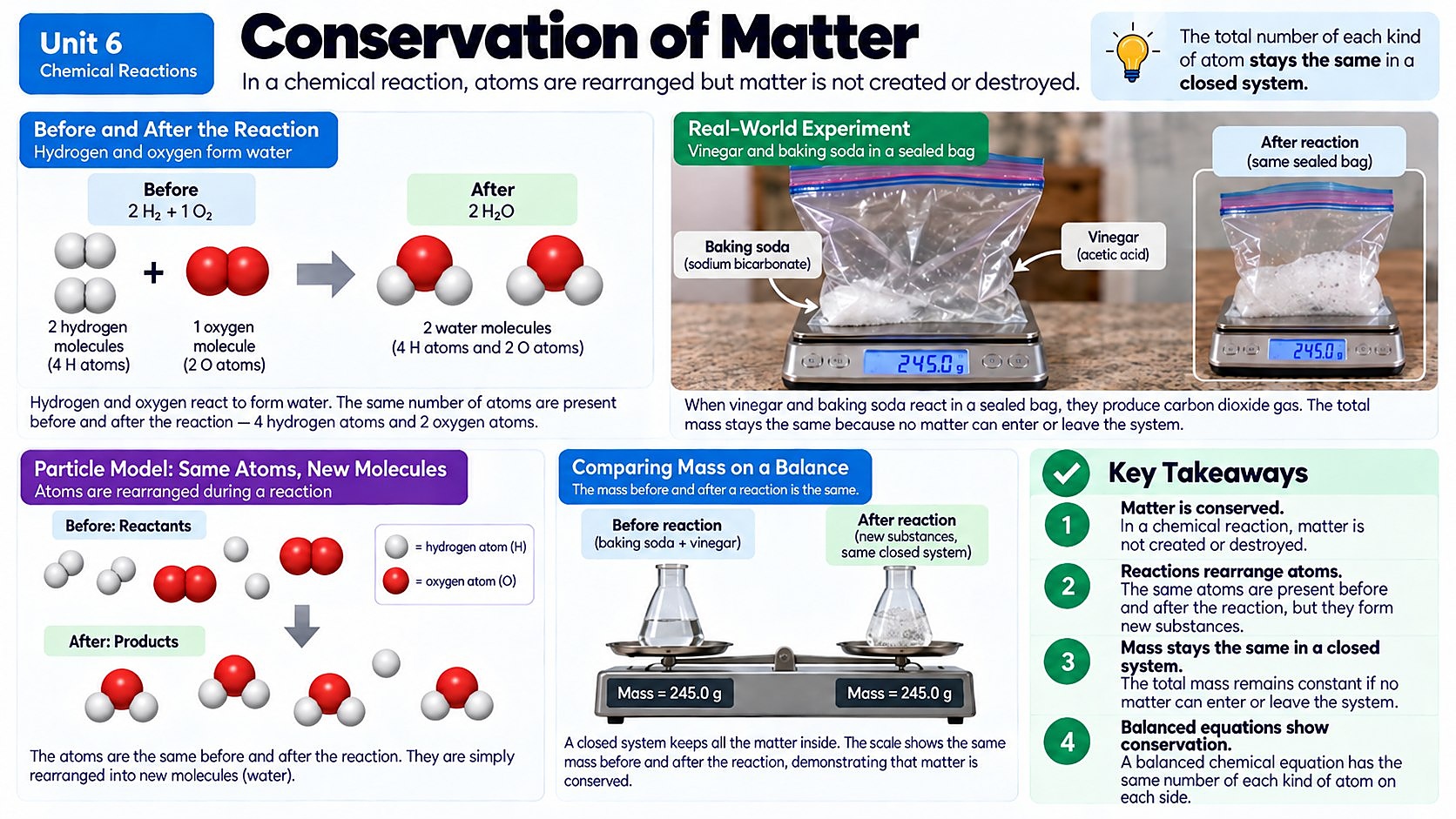
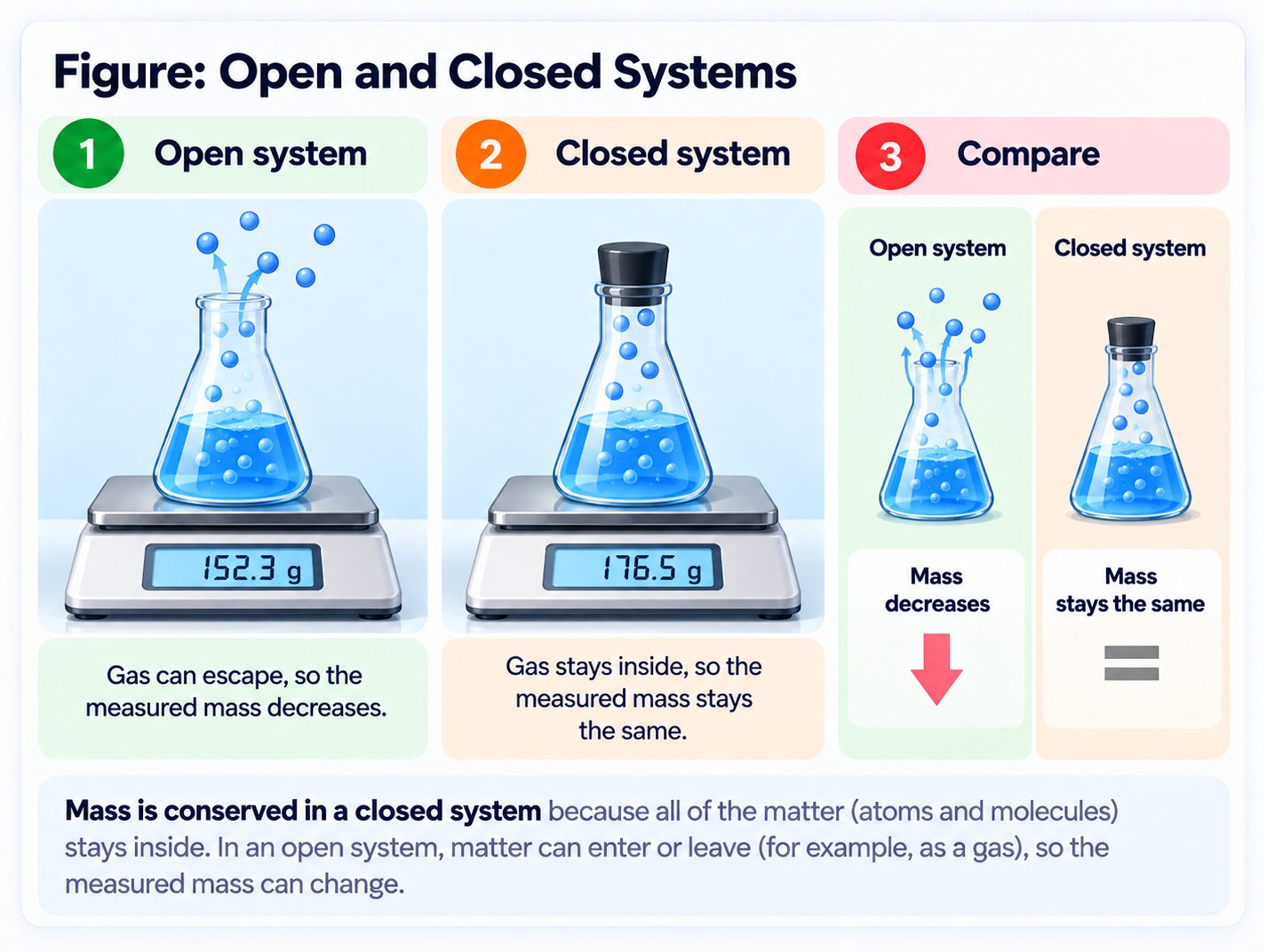
In every chemical reaction, from a match burning to a rocket launching, atoms are rearranged - never created, and never destroyed. This idea is important enough to be called a law: the law of conservation of matter. It means that in a closed system (one where nothing can enter or leave), the total mass measured before a reaction will exactly equal the total mass measured after it, no matter how dramatic the reaction looks.
Chemists show this balance using chemical equations, and a properly written equation must be balanced - meaning the same number of each type of atom appears on both sides of the arrow. For example, when hydrogen and oxygen combine to form water, the balanced equation is 2H2 + O2 to 2H2O. Count the atoms: four hydrogen atoms and two oxygen atoms on the left, four hydrogen atoms and two oxygen atoms on the right. Nothing was gained, nothing was lost - just rearranged into a new molecule.
It's easy to fall into a common trap here: thinking that because a reaction produces smoke, gas, or ash that seems to vanish into the air, matter must have been lost. When wood burns in a campfire, the log visibly shrinks down to a small pile of ash, and it's tempting to think most of the wood's mass just disappeared. It didn't. Burning wood combines carbon and hydrogen atoms in the wood with oxygen atoms from the air, releasing most of that mass as carbon dioxide gas and water vapor, both of which drift away invisibly into the atmosphere. If you could somehow capture every molecule of ash, smoke, and gas produced and weigh it all together, along with any leftover oxygen, it would exactly match the combined starting mass of the wood and the oxygen it reacted with.
Nature's Neat Freak: Crystalline Structures
Here's a pattern worth noticing: when solid materials form naturally, out in the world without any human interference, they overwhelmingly end up as crystalline structures - repeating, orderly, geometric patterns of atoms or ions. Table salt, quartz, diamonds, snowflakes, and the minerals inside rocks all form this way. Given enough time and the right conditions, atoms naturally settle into these tidy, repeating, low-energy arrangements, almost like they're seeking out the most efficient way to pack together.
Snowflakes are a beautiful example of this principle in action. Water vapor high in a cold cloud slowly loses energy and settles directly into ice, and because water molecules are naturally shaped to link together at specific angles, they lock into a six-sided crystal pattern every single time. That's why every snowflake, no matter how different it looks from its neighbors, always has six-fold symmetry - the underlying molecular geometry of H2O leaves the growing crystal no other natural option.
The Rule-Breakers: Glass, Wax, Plastic, and Gel
But not every solid follows this pattern - and the exceptions are almost all things humans make. Glass, wax, plastic, and gels are amorphous, meaning their atoms and molecules are jumbled and disordered rather than arranged in a repeating crystal pattern. Glass, for instance, is made by heating sand until it melts and then cooling it so fast that its atoms never get the chance to line up into an orderly lattice - they get frozen in place, disordered, like a crowd of people who all sat down at once instead of forming neat rows. Plastics are similar in spirit: they're built from long, tangled polymer chains that coil and knot together rather than stacking neatly.
Materials like this are rare in nature specifically because nature usually has plenty of time for atoms to settle into their preferred crystalline arrangement. Amorphous materials mostly show up when humans intervene and force a fast, controlled process that atoms wouldn't naturally choose on their own.
Rearranging Atoms Takes Energy
That intervention doesn't come for free. Manufacturing synthetic materials means taking natural raw materials, like petroleum (crude oil), sand, or plant matter, and using energy to break their existing chemical bonds and force the atoms into new arrangements. Turning crude oil into plastic pellets, or sand into glass, requires intense heat, pressure, or chemical processing, and that energy very often comes from burning fossil fuels.
So even though the law of conservation of matter guarantees that every atom in a plastic water bottle can be traced back to atoms that existed in crude oil long before, getting from one to the other wasn't free. It took a real, measurable input of energy - which is exactly why manufacturing synthetic materials has both benefits and costs worth thinking carefully about, which is where we're headed next.
Worked Example: Balancing a Different Kind of Reaction
Let's balance a reaction step by step: iron rusting, written as 4Fe + 3O2 → 2Fe2O3. Before trusting this equation, check it the way a scientist would - atom by atom. On the left side, count 4 iron atoms and 3 oxygen molecules, which is 3 times 2, or 6 oxygen atoms total. On the right side, each Fe2O3 unit contains 2 iron atoms and 3 oxygen atoms, and since there are 2 of them, that's 4 iron atoms and 6 oxygen atoms total. Four iron atoms and six oxygen atoms on both sides - the equation balances perfectly.
This matters because an unbalanced equation isn't just messy, it's physically impossible. If someone wrote 4Fe + 3O2 → Fe2O3 with only one iron-oxide unit on the right, they'd be claiming that iron and oxygen atoms vanished during the reaction, which breaks the law of conservation of matter. Chemists balance equations precisely so the math on paper matches what actually happens to real atoms in the real world: rearranged, never lost.
Reading a Chemical Equation Properly
A chemical equation packs a lot of information into very few characters, and once you know the parts, equations stop looking like a secret code. Everything to the left of the arrow is a reactant: the substances you start with. Everything to the right is a product: the substances you end up with. The arrow does not mean "equals." It means "reacts to form," and it points in the direction the change runs.
Two different kinds of numbers appear, and mixing them up is the single most common mistake in this whole topic. A small number written below and to the right, called a subscript, tells you how many atoms of that element are in one unit of the substance. In H2O, the subscript 2 means each water molecule contains two hydrogen atoms. A large number written in front of a formula, called a coefficient, tells you how many of those whole units you have. In 2H2O you have two entire water molecules, which works out to four hydrogen atoms and two oxygen atoms.
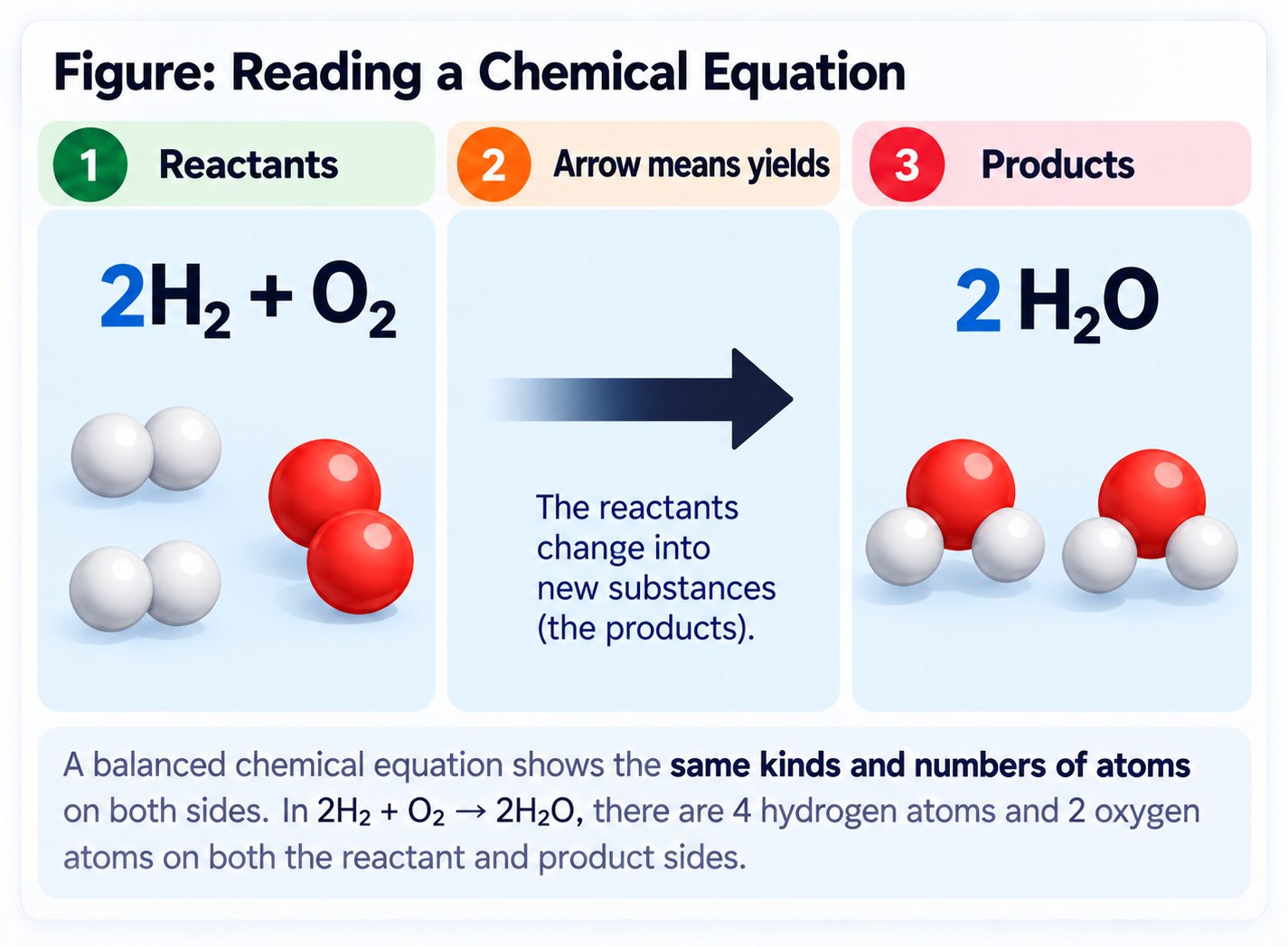
That difference is exactly why balancing works the way it does. When you balance an equation, you are only ever allowed to change the coefficients, never the subscripts. Changing a coefficient means using more or fewer of a substance, which is perfectly reasonable. Changing a subscript means inventing a completely different substance: H2O is water, but H2O2 is hydrogen peroxide, which you would not want to drink. Balancing the iron equation by rewriting Fe2O3 as Fe2O2 would make the atom count come out even and would also mean you were no longer describing rust.
So the whole balancing procedure is really just conservation of matter with rules attached: adjust how many units of each substance you have until every element has the same number of atoms on both sides, while leaving the identity of every substance untouched.
Atom Count Before and After a Reaction
Real-World Connections
Recycling Aluminum Cans
Melting down and reshaping aluminum cans into new products doesn't destroy or create a single atom of aluminum: the same atoms just get rearranged into a new form, which is why aluminum can be recycled indefinitely.
Composting Food Scraps
When food scraps decompose into compost, the atoms that made up a banana peel don't disappear: they're rearranged into new molecules that become nutrients in the soil.
Meet the Scientist
Environmental Engineers
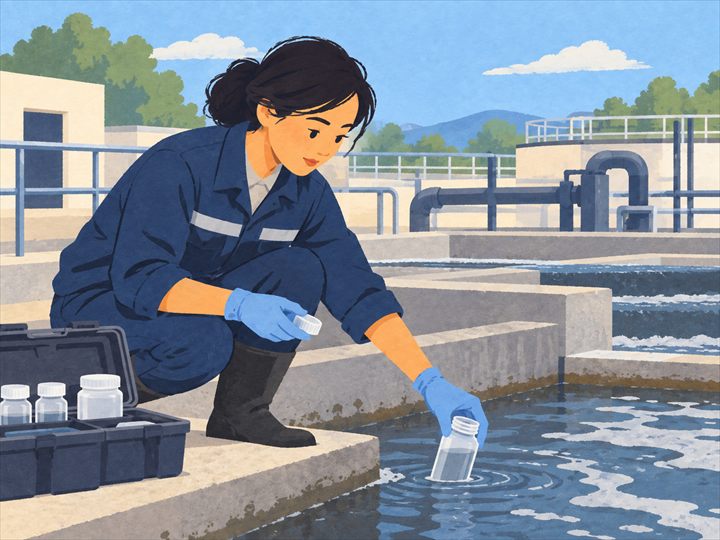
Environmental engineers track exactly where matter goes in recycling systems, landfills, and pollution cleanup projects, using the law of conservation of matter to trace every atom of a pollutant or resource as it moves through air, water, and soil.
- Average salary in Southern California
- About $121,000 a yearBased on pay for environmental engineers in the L.A., Orange County, Inland Empire, San Diego, and Ventura areas (U.S. Bureau of Labor Statistics, May 2025).
- Science classes to take
- High schoolCollege
Key Vocabulary
Bold, underlined words in the reading above are clickable too. Tap one to see its definition pop out. Or click or tap a card below to reveal the definition.
Explore More
Chapter Review
1. According to the law of conservation of matter, what happens to the total mass inside a sealed container during a chemical reaction?
2. In the balanced equation 2H2 + O2 to 2H2O, how many total hydrogen atoms are on each side?
3. Why do most naturally-formed solid materials, like quartz or table salt crystals, end up as crystalline structures?
4. Why is glass considered an amorphous material instead of a crystalline one?
5. Turning crude oil into plastic requires which of the following?
Design the Experiment
California Science Test (CAST) Practice
A student reacts 5 g of baking soda with 50 g of vinegar in two identical flasks. Flask 1 is left open to the air. Flask 2 has a balloon stretched tightly over its opening so no gas can escape. The student measures total mass before and after the reaction in each setup.
| Setup | Mass Before Reaction (g) | Mass After Reaction (g) |
|---|---|---|
| Flask 1 (open to air) | 55.0 | 52.7 |
| Flask 2 (sealed with balloon) | 55.0 | 55.0 |
Which claim is best supported by the data in the table?