

Two Suspects: Speed and Mass
When people imagine what makes a car crash more or less damaging, two factors usually come to mind: how fast the vehicle was going, and how much it weighs. Both matter, but not equally. It turns out that speed plays a much bigger role in the amount of damage a collision causes than mass does. That might seem surprising, since a heavier truck obviously carries more force than a lightweight bicycle, but the relationship between speed and kinetic energy is what makes speed such a big deal.
This is actually a common misconception worth untangling: people often assume that a bigger, heavier vehicle is automatically the more dangerous one in a collision, full stop. But a small compact car speeding at 70 miles per hour can unleash more destructive kinetic energy than a much heavier delivery truck poking along at 15 miles per hour in a parking lot. That doesn't mean mass is irrelevant: a heavier vehicle moving at the same speed as a lighter one absolutely carries more kinetic energy and can do more damage. It just means you can't judge a collision's severity by mass alone without also knowing the speed, because speed's effect on kinetic energy is so much more powerful.
Why Speed Matters So Much
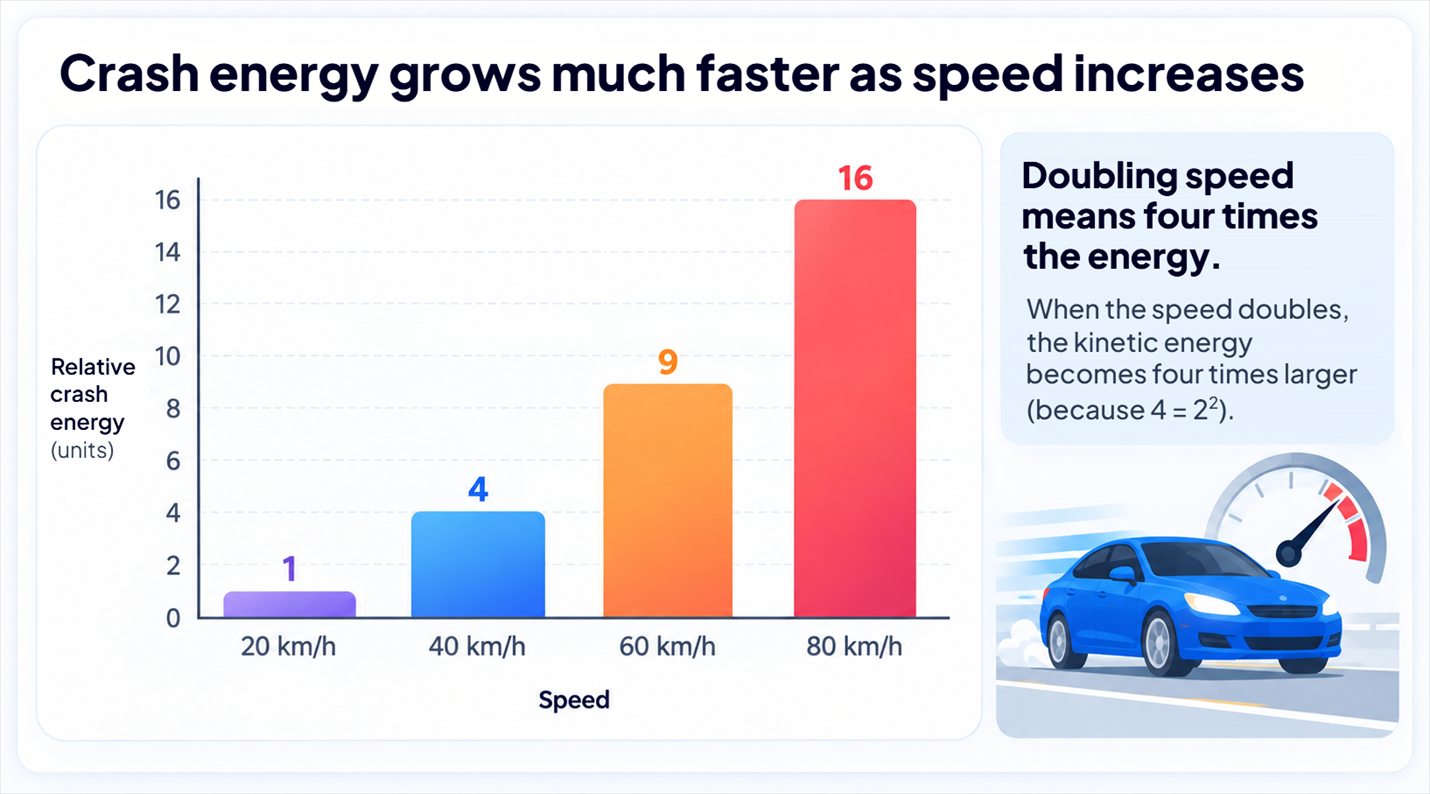
Kinetic energy doesn't just increase in a simple, one-to-one way as speed increases; it increases much faster than that, because kinetic energy depends on speed multiplied by itself. In practical terms, this means that doubling a truck's speed doesn't just double its kinetic energy; it roughly quadruples it. That's why crashing at 60 miles per hour is dramatically more destructive than crashing at 30 miles per hour, even though the speed only doubled. Meanwhile, doubling a truck's mass while keeping its speed the same only roughly doubles its kinetic energy. Speed simply has a much more powerful effect on how much energy gets unleashed in a collision.
Here's what that looks like with real numbers. Imagine a 1,000-kilogram car's kinetic energy is 50,000 joules at 10 meters per second. If that same car speeds up to 20 meters per second (double the speed), its kinetic energy doesn't become 100,000 joules, it jumps all the way to 200,000 joules, four times as much. If it kept going and reached 30 meters per second, triple the original speed, its kinetic energy would climb to 450,000 joules, nine times the original amount. Notice the pattern: 2 times the speed gives 4 times the energy, and 3 times the speed gives 9 times the energy, because kinetic energy scales with speed multiplied by itself. That squared relationship is exactly why highway crashes tend to be so much more violent than parking-lot fender benders, even when the speed difference sounds small.
Mass, Force, and Acceleration
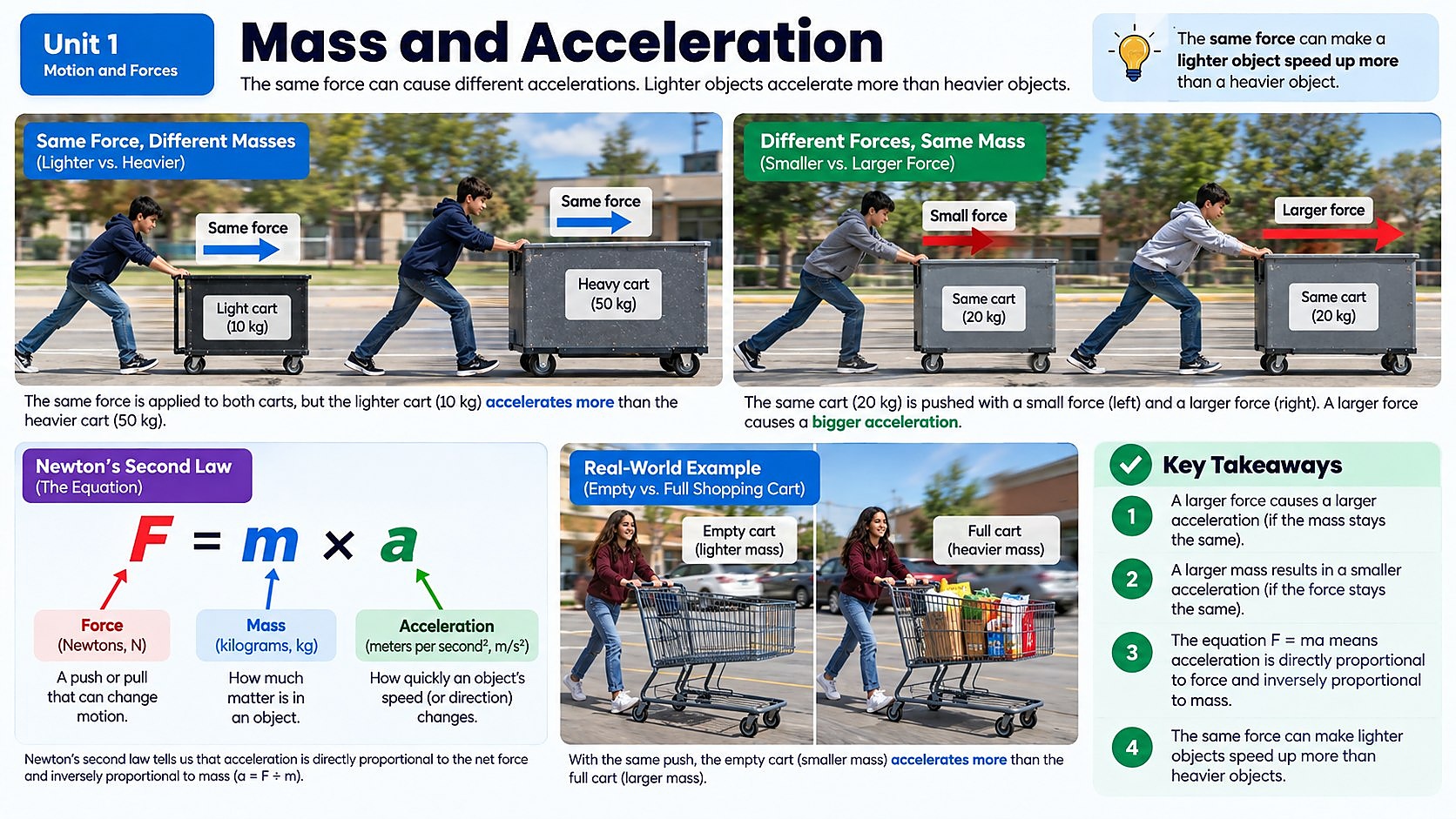
Mass still matters too, especially when it comes to acceleration, which is any change in an object's speed or direction over time. For a given push or pull (a given force), a more massive object accelerates less than a less massive one. Think about pushing an empty shopping cart versus pushing one that's completely full of canned goods: the same push barely budges the full cart but sends the empty one rolling quickly. This relationship connects mass, force, and acceleration together: for the same net force, more mass means less acceleration, and less mass means more acceleration.
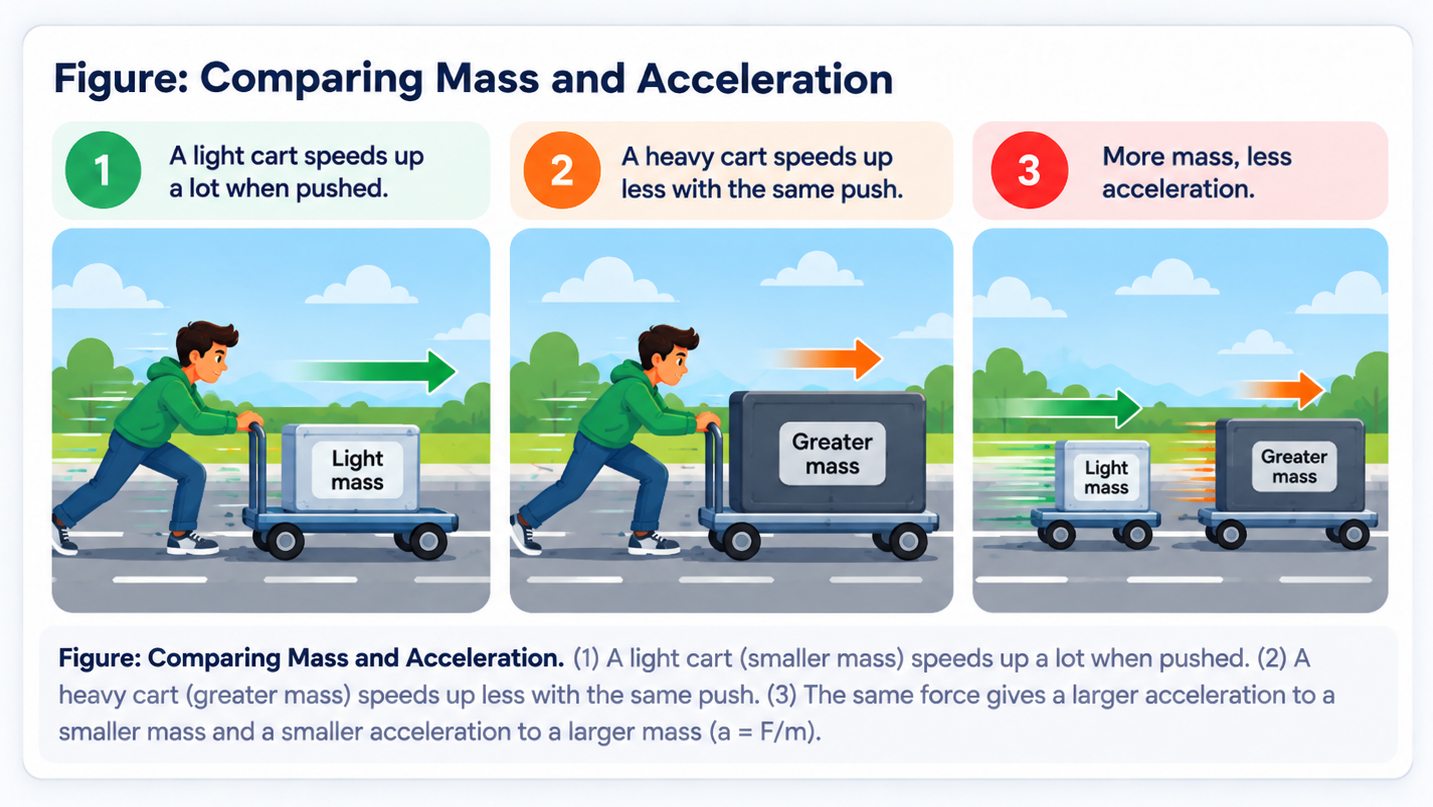
This matters for our crash scenario too. If the same braking force is applied, a lighter car will slow down (decelerate) faster than a heavier one. That's part of why fully loaded trucks need much longer distances to stop safely than empty cars: their larger mass means the same braking force produces a smaller change in speed each second.
Why School Zones Have Such Low Speed Limits
This squared relationship between speed and kinetic energy is exactly why school zones and neighborhood streets often post speed limits as low as 15 or 20 miles per hour, while highways allow 65 or 70. Traffic safety researchers have found that pedestrians struck by a car at 20 miles per hour survive the vast majority of the time, but that survival rate drops sharply once vehicle speeds climb toward 40 miles per hour, because the kinetic energy involved in the impact has grown so much faster than the speed itself.
Slowing traffic down by what seems like a small amount, say from 35 to 20 miles per hour, actually removes a huge chunk of the kinetic energy available to cause harm in a collision, precisely because of the squared relationship you just learned about. It's a great example of how a single mathematical pattern (kinetic energy depending on speed squared) directly shapes real rules that keep people safe every single day.
Putting Numbers on It: Newton's Second Law
Everything this chapter has said about force, mass, and acceleration gets tied together by one rule. Newton's second law of motion says that the acceleration of an object equals the net force divided by the mass, and that the acceleration points in the same direction as the net force. Written out, acceleration = net force ÷ mass. Multiply both sides by the mass and you get the version most people memorize: net force = mass × acceleration.
Read that equation slowly, because it says both halves of what you already knew. Keep the force the same and increase the mass, and the acceleration has to shrink, since you are dividing by a bigger number. That is the loaded cart versus the empty cart. Keep the mass the same and increase the force, and the acceleration grows. That is why shoving harder gets the cart moving faster.
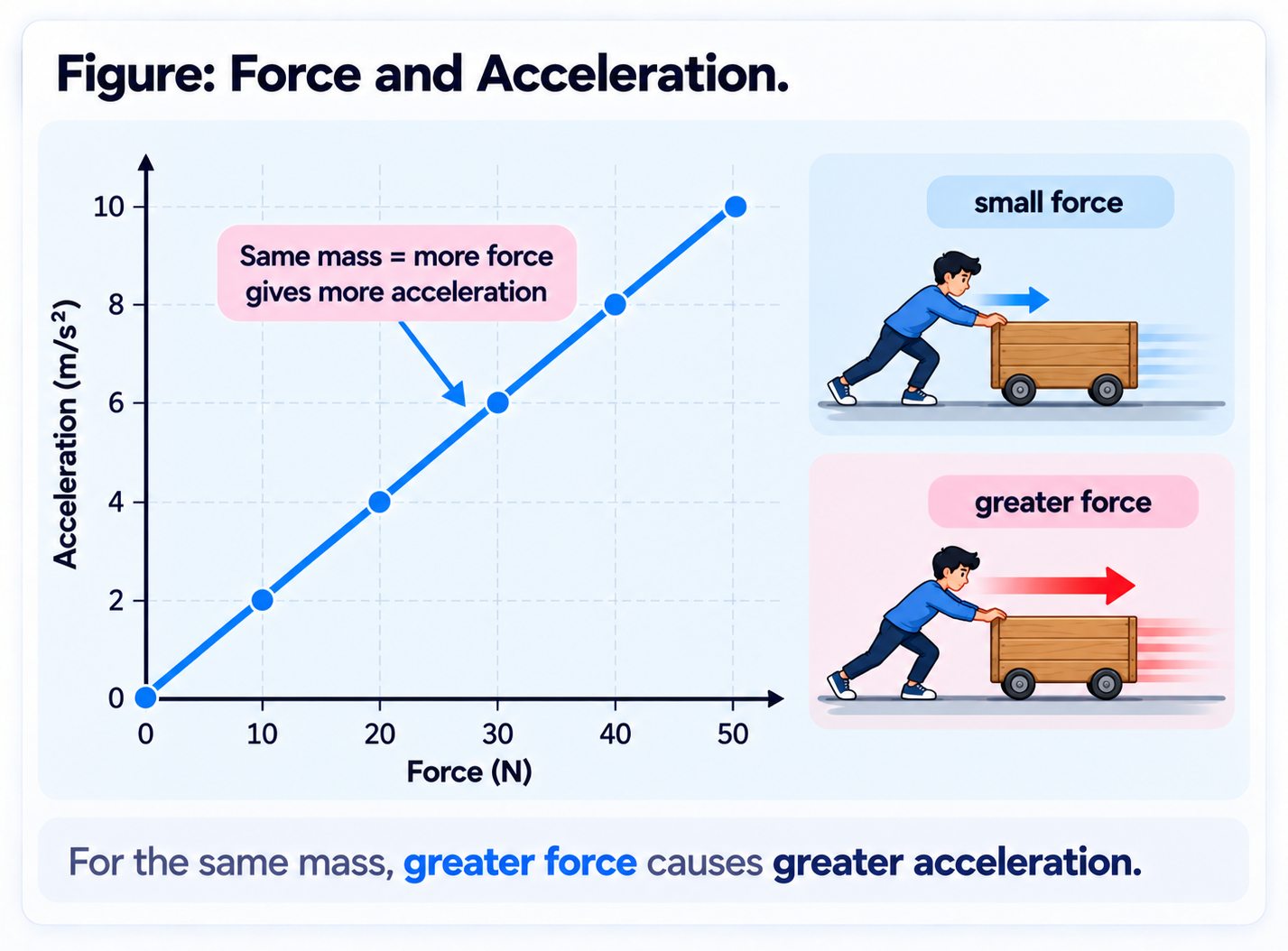
The units fit together neatly. Force is measured in newtons, mass in kilograms, and acceleration in meters per second squared, which means one newton is the force it takes to accelerate one kilogram at one meter per second every second. Try it with the sedan from this chapter's data: a 1,200 kg car with 6,000 N of braking force slows at 6,000 ÷ 1,200 = 5 m/s². Double the mass to 2,400 kg with the same 6,000 N and you get 6,000 ÷ 2,400 = 2.5 m/s², exactly half. The equation predicts the table.
Weight Is Not the Same Thing as Mass
People use "weight" and "mass" as though they mean the same thing, and in everyday conversation that is harmless, but in science they are genuinely different quantities. Mass is the amount of matter in an object, measured in kilograms. Weight is a force: the pull of gravity on that object, measured in newtons like any other force. When you step on a bathroom scale, you are not measuring your matter. You are measuring how hard Earth is pulling on you.
The difference shows up the moment you leave Earth. A book with a mass of 1 kg has a mass of 1 kg here, on Mars, or drifting in deep space, because it is made of the same amount of matter everywhere. Its weight, though, changes from place to place, because Mars pulls on it with a different gravitational force than Earth does. Same book, same mass, different weight.
This matters for the crash story because it is mass, not weight, that determines inertia and acceleration. When you use Newton's second law, the number you divide by is the mass in kilograms. An astronaut's loaded toolbox floating in orbit weighs essentially nothing, yet shoving it still takes real effort, because its mass, and therefore its inertia, came along for the ride.
Real-World Connections
Loaded Moving Trucks
A moving truck packed full of furniture needs a far more powerful engine to accelerate at the same rate as an empty pickup, simply because it has so much more mass to push.
Pushing a Full Shopping Cart
It takes noticeably more effort to get a shopping cart rolling once it's full of groceries than when it was empty: the mass changed, but your force didn't automatically increase to match.
Meet the Scientist

Automotive Powertrain Engineers
These engineers decide exactly how powerful an engine needs to be for a given vehicle. A pickup truck designed to tow heavy trailers needs a much stronger engine than a small commuter car, precisely because it must produce enough force to accelerate all that extra mass at a reasonable rate.
- Average salary in Southern California
- About $122,000 a yearBased on pay for mechanical engineers in the L.A., Orange County, Inland Empire, San Diego, and Ventura areas (U.S. Bureau of Labor Statistics, May 2025).
- Science classes to take
- High schoolCollege
Key Vocabulary
Bold, underlined words in the reading above are clickable too. Tap one to see its definition pop out. Or click or tap a card below to reveal the definition.
Explore More
Chapter Review
1. Which factor plays a greater role in the amount of damage caused by a collision?
2. If a truck's speed doubles, what happens to its kinetic energy (roughly)?
3. For the same applied force, how does a more massive object's acceleration compare to a less massive one's?
4. Why do fully loaded trucks generally need longer braking distances than empty cars?
5. Which best defines acceleration?
Design the Experiment
California Science Test (CAST) Practice
A 1,000-kilogram test car was driven at three different speeds, and its kinetic energy was calculated at each speed using motion sensors.
| Speed (m/s) | Kinetic Energy (J) |
|---|---|
| 10 | 50000 |
| 20 | 200000 |
| 30 | 450000 |
According to the data table, when the car's speed doubles from 10 m/s to 20 m/s, what happens to its kinetic energy?